
The Royal Navy’s recent deployment of ROV systems aboard RFA Lyme Bay, as it sails from Gibraltar for a potential mine countermeasures mission in the Strait of Hormuz, is a useful moment to reflect on how underwater ordnance disposal is changing and why it matters beyond the defence sector.
The fundamental principle driving that deployment is one the subsea industry has long understood: use remote means wherever possible. Keep people away from the hazard. Let the technology do the dangerous work.
It sounds obvious. In practice, it has taken considerable engineering effort to get there.
The challenge with UXO disposal
Locating a mine or piece of unexploded ordnance underwater is one problem. Disposing of it safely is another entirely. Historically, that second step has often meant putting a diver in the water, in poor visibility, in difficult conditions, close to an object that could detonate without warning.
In environments like the Gulf, where visibility can deteriorate to the point where divers have been known to search by touch, the risk involved in conventional approaches is significant. The pressure to act quickly, to clear a route, reopen a shipping lane, or make an asset safe, compounds that risk further.
The answer is a reliable, remotely operated firing solution that removes the operator from the immediate danger zone entirely.
What the Tornado Firing System does
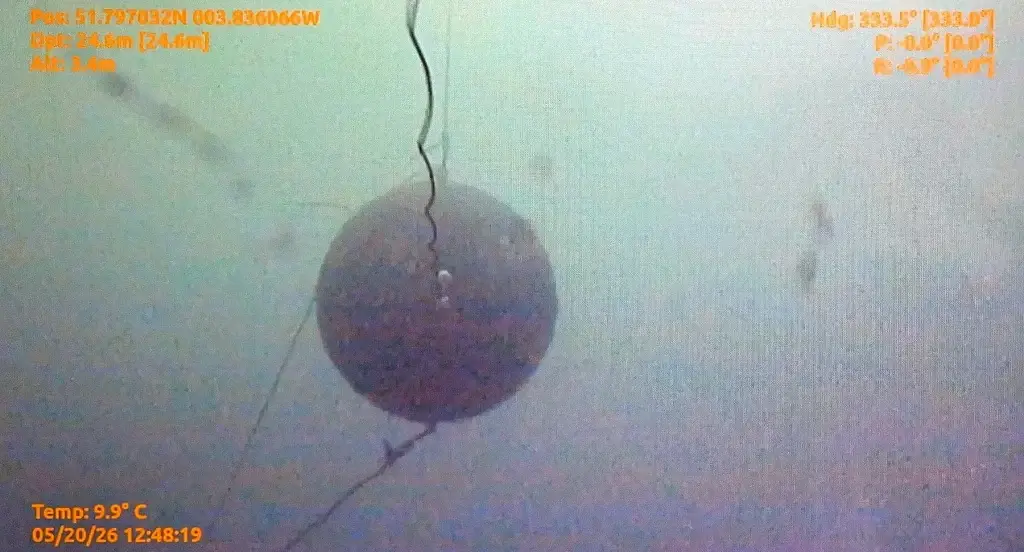
The Tornado Firing System is the critical link between the surface and the ordnance. Once an ROV has navigated to the device, attached the disposal charge, and withdrawn to a safe distance, Tornado delivers the detonation command from the surface. Controlled, precise, and with no diver required.
The value isn’t just the detonation itself. It’s the confidence that the entire sequence, from approach and attachment through to withdrawal and firing, can be completed remotely in conditions that would previously have grounded the operation or forced an unacceptable compromise on safety.
Where this is heading
The Royal Navy’s deployment is a signal, not an anomaly. Across defence, energy, and infrastructure, the demand for compact, rapidly deployable ROV systems capable of performing complex subsea tasks is growing. The days of treating ROVs as a convenient alternative to divers in low-risk situations are giving way to a broader recognition: these systems can handle genuinely dangerous work, reliably, at pace.
For operators in any sector managing subsea assets near unexploded ordnance, whether offshore, in ports, or in inland waterways, the question is increasingly not whether to use an ROV-led approach, but which system and which team.
At Atlantas Marine, we supply and operate systems built for exactly this work. If you have a UXO disposal challenge or want to understand how remotely operated firing technology could reduce risk on your next project, we’d welcome the conversation.